Weeknight
How Long to Bake Salmon (by Thickness, Not Guesswork)
At 400°F (200°C), bake salmon for about 4–6 minutes per half-inch of thickness measured at the thickest point — so 8–12 minutes for a typical 1-inch fillet, 7–10 minutes at 425°F (220°C), or 11–14 minutes at 375°F (190°C). Pull it out at 125°F (52°C) internal for a moist, just-set centre; carryover heat carries it up another 5–7°F while it rests. The FDA-recommended safe temperature is 145°F (63°C), which is fully firm and noticeably drier.
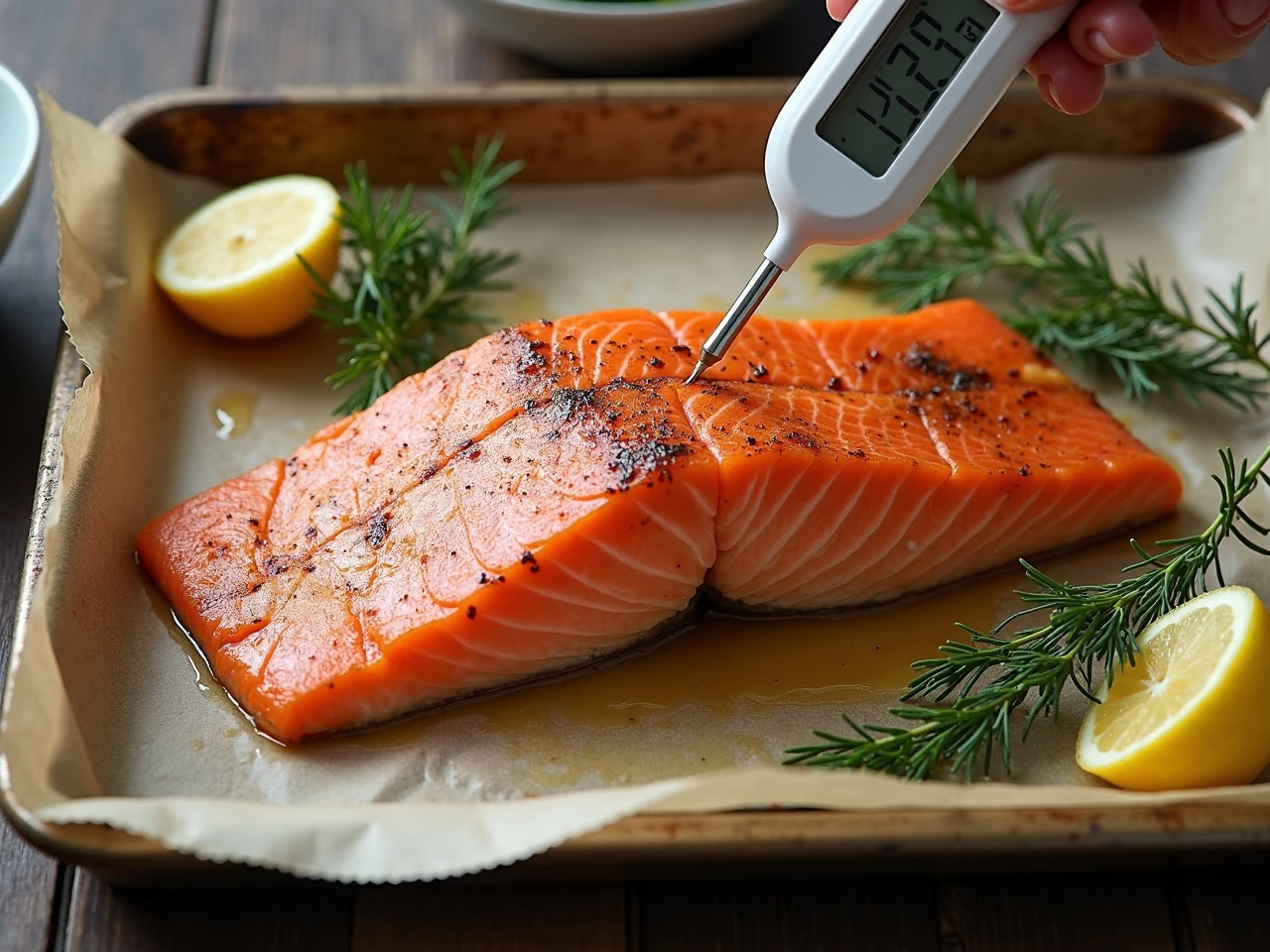
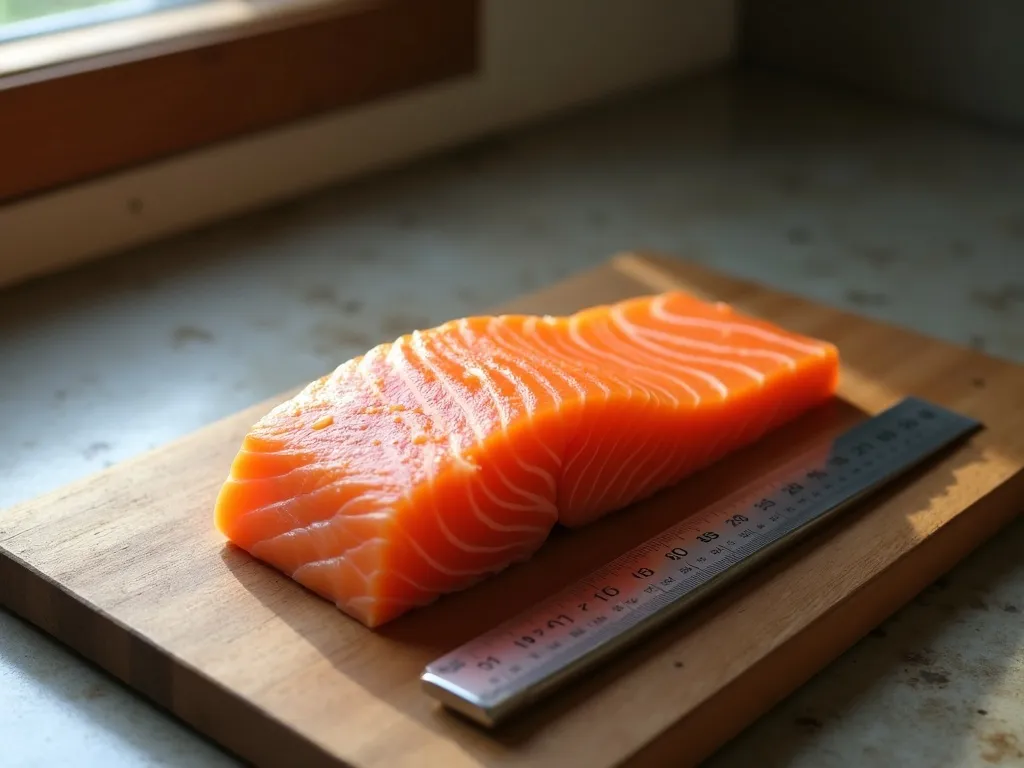
Most baked-salmon recipes give you a single number — “bake 12–15 minutes” — and that number is only correct for the fillet the writer happened to have. Salmon fillets vary from about half an inch at the tail to nearly two inches at the loin, and that range is the difference between a fillet that is perfect at 8 minutes and one that needs 15.
So the useful unit is not the fillet. It is the thickness at the thickest point.
The timing table
On a lined sheet pan, uncovered, from fridge-cool-but-not-cold. 400°F is the default; the other two columns are there because ovens are often already set for something else.
| Thickness at thickest point | 375°F (190°C) | 400°F (200°C) | 425°F (220°C) | What it is |
|---|---|---|---|---|
| 1/2 inch (1.3 cm) | 8–10 min | 6–8 min | 5–7 min | thin tail-end pieces |
| 3/4 inch (2 cm) | 10–12 min | 8–10 min | 6–8 min | small portion fillets |
| 1 inch (2.5 cm) | 11–14 min | 8–12 min | 7–10 min | standard supermarket fillet |
| 1 1/4 inches (3 cm) | 13–16 min | 11–14 min | 9–12 min | thick centre-cut |
| 1 1/2 inches (4 cm) | 15–18 min | 12–15 min | 10–13 min | loin-end or a small whole side |
The spread inside each row is real, not hedging. A fillet that has been sitting out for ten minutes lands at the low end; one straight from the fridge lands at the high end. Skin adds about a minute. Convection takes about two off.
Between the columns: 425°F sets the surface faster and gives a little colour, at the cost of a wider band of overcooked flesh under it, so it suits thin fillets best. 375°F is the gentlest and most even, and the right choice for thick centre-cut pieces or a whole side, where the outside would otherwise be well past done before the centre reached 125°F.
Pull temperature, not serving temperature
This is the part that actually determines whether the salmon is dry, and it is the part most recipes leave out.
Salmon keeps cooking after it leaves the oven. A 1-inch fillet gains 5–7°F in the four minutes it rests. So the temperature you pull at is not the temperature you eat at:
| Pull at | Rests to | Result |
|---|---|---|
| 120°F (49°C) | ~126°F | medium-rare, centre still deep translucent |
| 125°F (52°C) | ~131°F | just-set, large moist flakes — the default here |
| 130°F (54°C) | ~136°F | firm throughout, still moist |
| 138°F (59°C) | ~145°F | FDA-recommended fully cooked, noticeably drier |
The FDA’s recommended safe minimum is 145°F (63°C). If you are cooking for someone pregnant, immunocompromised, very young or elderly, cook to that and accept the firmer texture — pull at 138°F and let carryover finish it.
Checking without a thermometer
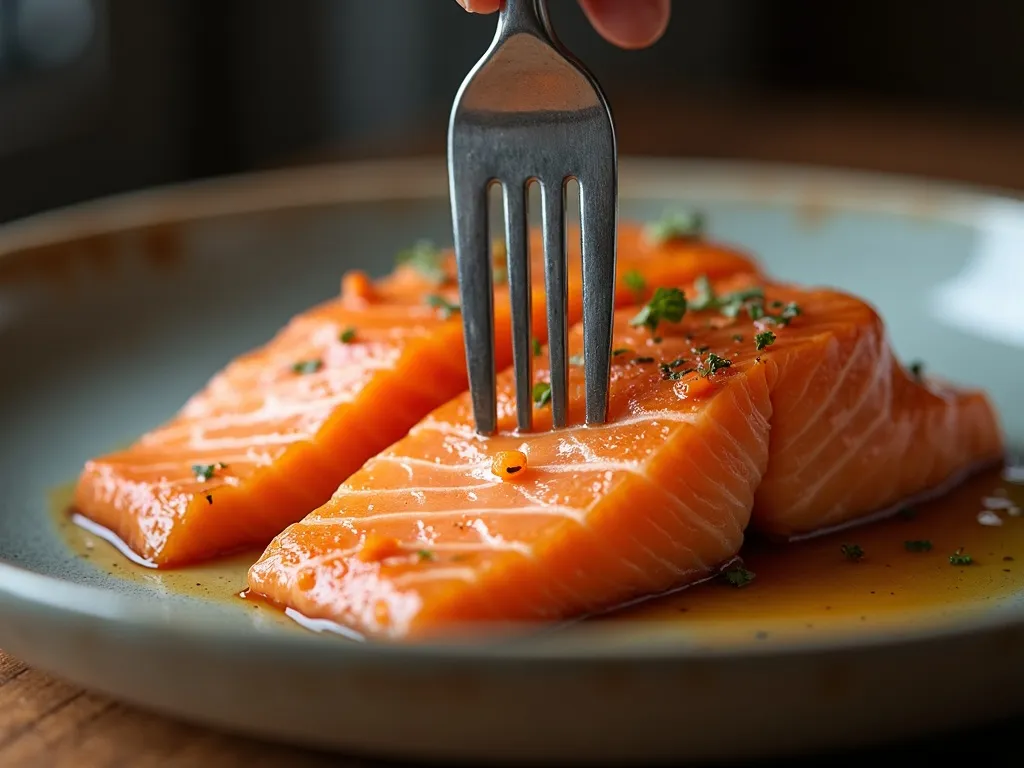
A thermometer is worth the £12, but the fork test is reliable once you know what you are looking for. Press the back of a fork into the thickest part and twist gently:
- Underdone: resists, and the flesh stays in one piece rather than separating.
- 125°F, what you want: separates into large flakes with light pressure, and the very centre still reads slightly darker and translucent.
- Overdone: falls apart with no resistance, uniformly pale and opaque all the way through, often with white albumin pooling on the surface.
Why fillets from the same pack cook differently
Buy four fillets and you will usually get two thick loin pieces and two thinner tail pieces. Cooked for the same time, the tails overshoot by several degrees.
Two fixes, both easy. Either fold the thin tail end of each small fillet under itself to double its thickness so all four match, or lay the thin pieces at the front of the pan and pull them out two to three minutes early. Neither takes extra time; both remove the single most common cause of “half the salmon was dry”.
The recipe below
The method that follows is the plain version — oil, salt, pepper, lemon. It is deliberately unseasoned beyond that, because the point of this page is the timing. Once the timing is right, everything else is preference.
How Long to Bake Salmon (by Thickness, Not Guesswork)
- Prep
- 5 min
- Cook
- 12 min
- Total
- 17 min
- Serves
- 4 fillets
Ingredients
- 4 salmon fillets, about 6 oz (170 g) each and 1 inch (2.5 cm) thick at the thickest point, skin on or off
- 1 tablespoon olive oil
- 3/4 teaspoon fine sea salt
- 1/4 teaspoon freshly ground black pepper
- 1 lemon, half sliced into thin rounds and half cut into wedges for serving
- 2 sprigs dill or flat-leaf parsley, optional
Method
- Heat the oven to 400°F (200°C) with a rack in the middle. Line a rimmed sheet pan with parchment. (10 min)
- Take the salmon out of the fridge while the oven heats. Fillets going in at fridge temperature run 2–3 minutes longer than the times below, and cook less evenly. (10 min)
- Pat the fillets dry on all sides with paper towel. This matters more than it sounds — surface water steams the top of the fish instead of letting it set.
- Rub the fillets with olive oil, then season with the salt and pepper. Lay them on the sheet pan with at least an inch of space between them, thickest side facing the middle of the oven.
- Measure the thickest part of a fillet. Bake for 4–6 minutes per half-inch: 8–12 minutes for a 1-inch fillet, 12–15 for 1.5 inches, 6–8 for a thin tail-end piece. (12 min)
- Start checking 2 minutes before the low end of the range. Insert an instant-read thermometer horizontally into the thickest part, stopping at the centre. Pull the pan at 125°F (52°C) for a just-set centre, 130°F (54°C) for firmer, 145°F (63°C) for the FDA-recommended fully cooked.
- Rest the salmon on the pan for 4 minutes. The centre climbs another 5–7°F in that time — this is the step that separates moist salmon from dry, and skipping it is why most home-baked salmon overshoots. (4 min)
- Serve with the lemon wedges and herbs.
Notes
- No thermometer? Press the top of the thickest part with the back of a fork. At 125°F it gives and separates into large flakes but the very centre still looks slightly translucent. If it flakes apart with no resistance and is uniformly opaque, it is past 145°F.
- Skin-on fillets: bake skin-side down. The skin acts as a heat buffer, and the fillet will run about a minute longer than a skinless one of the same thickness.
- Frozen fillets thawed in the fridge overnight behave like fresh. Cooking from frozen works but adds roughly 50% to the time and gives a wider band of overcooked flesh at the edges.
- A whole side of salmon is not the same as fillets: measure its thickest point and expect 20–25 minutes at 400°F, checking from 15.
- Farmed salmon is generally fattier than wild and is more forgiving of an extra minute. Wild sockeye is lean and thin — treat it as the low end of every range here.
Per serving (estimated by calculation from ingredient quantities, not laboratory tested): 342 kcal · 34 g protein · 1 g carbohydrate · 22 g fat.
Common questions
What temperature should baked salmon be inside?
The FDA recommends 145°F (63°C) measured at the thickest part. Most restaurant kitchens serve salmon well below that — pulled at 120–125°F (49–52°C) for medium-rare and 130–135°F (54–57°C) for medium. Pull 5–7°F below your target, because the centre keeps climbing while it rests. If you are cooking for someone pregnant, immunocompromised, very young or elderly, use the full 145°F.
How long does salmon take at 425°F instead of 400°F?
About 2–3 minutes less for a 1-inch fillet — roughly 7–10 minutes rather than 8–12. The higher heat gives you a slightly better surface but a wider band of overcooked flesh under it. At 375°F, add 2–3 minutes and expect a more evenly cooked fillet with almost no colour on top.
Why is my baked salmon always dry?
Almost always one of three things: the fillet was cooked to 145°F and then rested, which carries it to 150°F+; the timing was taken from a recipe written for a thicker fillet than yours; or the fish went in straight from the fridge, so the outside overcooked while the centre caught up. Measure thickness, use a thermometer, and pull early.
What is the white stuff that comes out of salmon?
Albumin — a protein that liquefies and pushes out as the muscle fibres contract. It is harmless and edible. A lot of it means the fish was cooked hot and hard; you get less of it by baking at a moderate temperature and pulling the fish earlier.
Should salmon be baked covered or uncovered?
Uncovered, for the timings on this page. Covering with foil traps steam and effectively poaches the fish — it stays moist but the surface never sets, and it runs 2–4 minutes longer. Cover only if you are baking with a sauce you want to keep liquid.