Weeknight
How Long to Cook Chicken Drumsticks in the Oven
Bake chicken drumsticks at 425°F (220°C) for 35–40 minutes, turning once at the halfway point; at 400°F (200°C) allow 45–50 minutes, and at 375°F (190°C) 50–55 minutes. Cook them to an internal temperature of 175–185°F (79–85°C) at the thickest part, not 165°F — dark meat is full of connective tissue that only softens above 175°F, so a drumstick pulled at 165°F is safe but chewy. 425°F gives the crispest skin; the lower temperatures cook more evenly but need a 5–8 minute finish at 450°F to crisp.
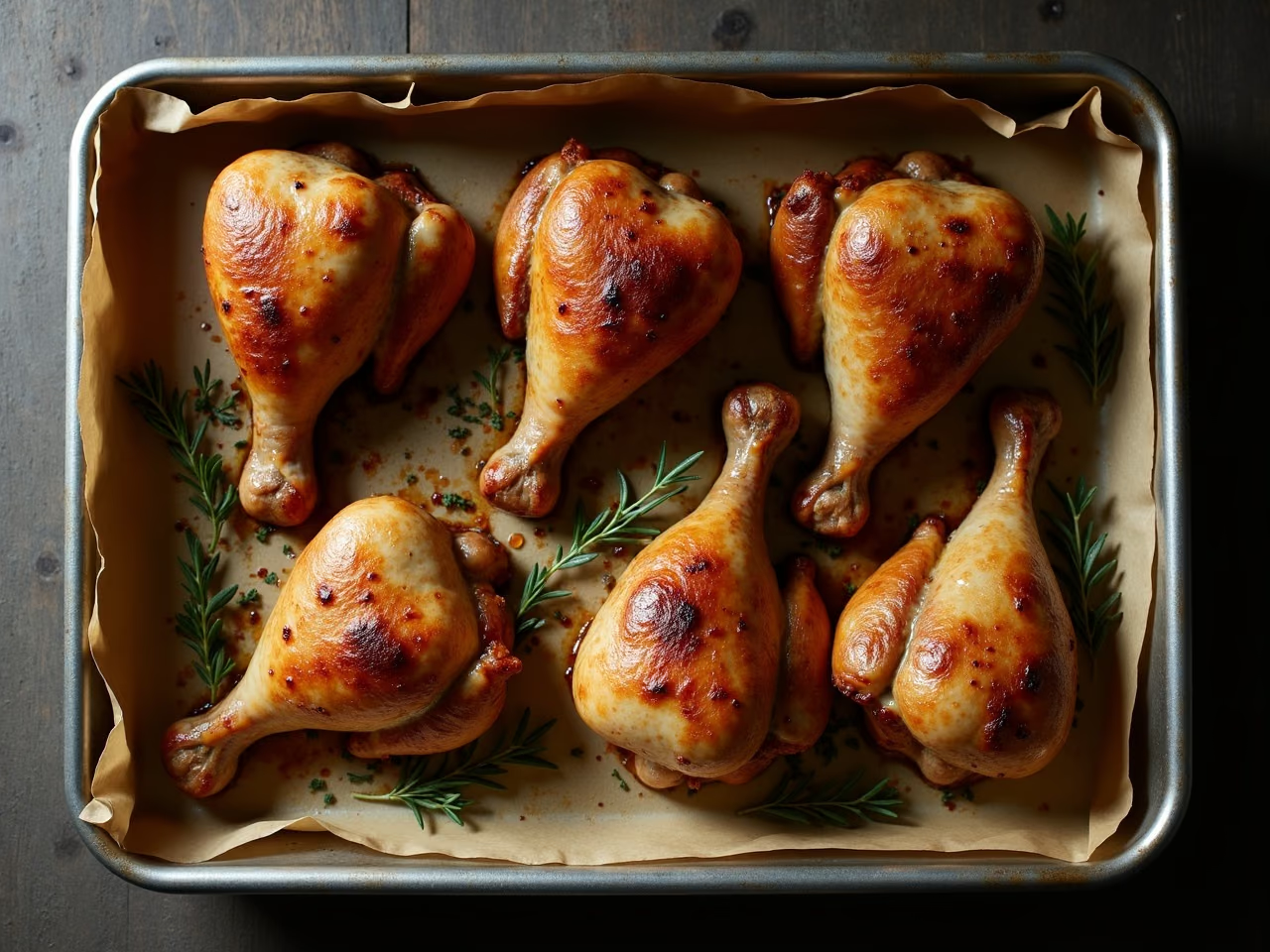
Chicken drumsticks are the cut most often ruined by following advice written for chicken breast. “Cook to 165°F and stop” is correct for a breast and wrong for a drumstick, and the difference is the whole point of this page.
The times
On a wire rack, turning once at the halfway point:
| Drumstick size | Time at 425°F (220°C) | Time at 400°F (200°C) | Time at 375°F (190°C) |
|---|---|---|---|
| Small (about 3 oz / 85 g) | 30–35 min | 40–45 min | 45–50 min |
| Medium (about 4 oz / 115 g) | 35–40 min | 45–50 min | 50–55 min |
| Large (about 5 oz / 140 g) | 40–45 min | 50–55 min | 55–60 min |
Sizes vary a lot between packs, so treat these as the window to start checking in rather than a finish line.
Which temperature to use. 425°F is the default on this page because it renders the fat and crisps the skin in the same window the meat needs to reach 180°F. 400°F is the fallback when the skin is browning ahead of the inside, or when something else is sharing the oven. 375°F cooks the most evenly and is the right setting if the drumsticks are going into a sauce or a lunchbox where crisp skin does not matter — on its own it leaves the skin soft, so finish with 5–8 minutes at 450°F (230°C) if you want both.
Cook dark meat past 165°F
This is the part most recipes get wrong.
165°F (74°C) is the temperature at which chicken is safe. It is not the temperature at which a drumstick is good. Legs and thighs are working muscles, dense with collagen in the connective tissue and around the tendons. Collagen does not soften at 165°F. It starts converting to gelatin at around 175°F, and the process runs properly between 175 and 185°F.
That gelatin is what makes dark meat succulent rather than merely cooked. Pull a drumstick at 165°F and it is safe, but it will be springy and the meat will grip the bone. Take it to 180°F and it releases cleanly and tastes richer — and because dark meat has far more fat and connective tissue than breast, it does not dry out on the way there.
| Internal temp | Result |
|---|---|
| 165°F / 74°C | safe, but chewy and clings to the bone |
| 175°F / 79°C | collagen starting to break down, noticeably better |
| 180°F / 82°C | the sweet spot for drumsticks |
| 185°F / 85°C | very tender, meat falling off the bone |
| 195°F+ / 90°C+ | stringy; the fat has rendered out |
The wire rack and the baking powder
Two small things do most of the work on the skin.
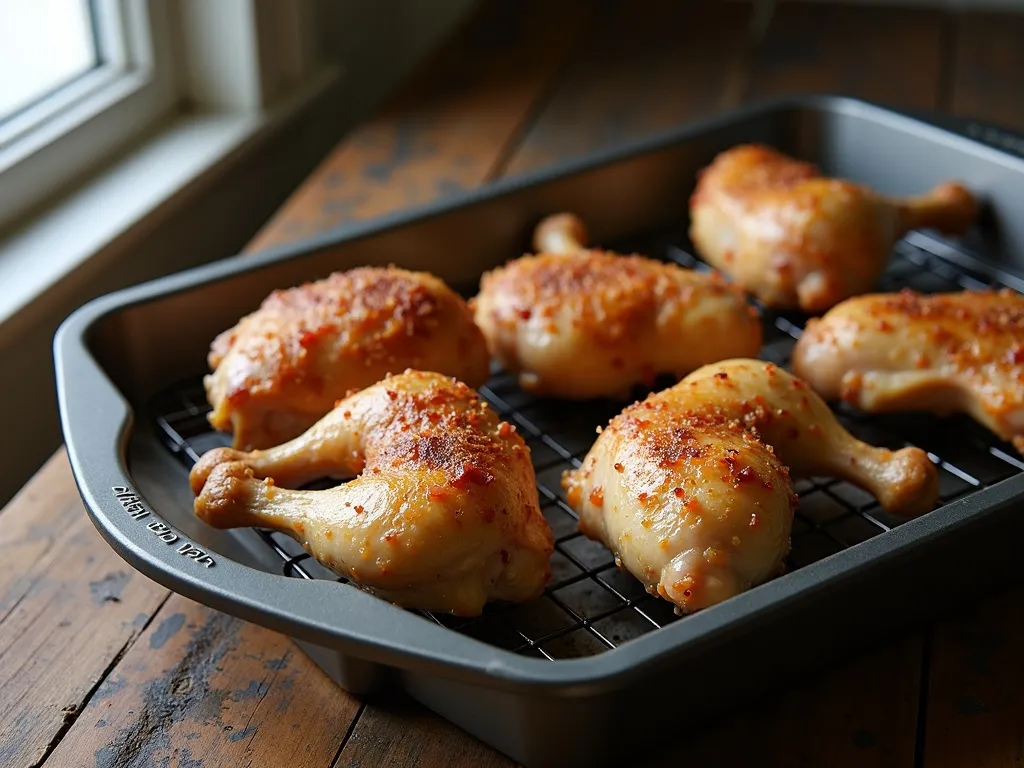
The rack lifts the drumsticks out of the fat they render. Sitting flat on a pan, the underside of each drumstick effectively deep-fries at low temperature and comes out pale and soft. Raised, hot air circulates underneath and the whole surface crisps.
The baking powder — a teaspoon tossed through the seasoning — raises the pH of the skin. Browning reactions run faster at higher pH, and the alkaline surface also helps draw moisture out. The result is a drier, crisper, more evenly browned skin than oil alone. Use baking powder, not baking soda: soda at this quantity leaves a soapy, metallic taste.
Where to put the thermometer
Slide the probe into the thickest part of the drumstick, running parallel to the bone and stopping about halfway. Do not let the tip touch the bone — bone conducts heat differently from meat and will read high, telling you it is done several minutes before it is.
Check the largest drumstick on the pan. If that one is at 180°F, the smaller ones certainly are.
How Long to Cook Chicken Drumsticks in the Oven
- Prep
- 10 min
- Cook
- 40 min
- Total
- 50 min
- Serves
- 8 drumsticks
Ingredients
- 8 chicken drumsticks, about 3 lb (1.4 kg) total
- 1 tablespoon neutral oil
- 1 1/2 teaspoons fine sea salt
- 1 teaspoon baking powder (not baking soda) — this is what crisps the skin
- 1 teaspoon smoked paprika
- 1/2 teaspoon garlic powder
- 1/2 teaspoon freshly ground black pepper
Method
- Heat the oven to 425°F (220°C). Set a wire rack inside a rimmed sheet pan. The rack matters — it lets hot air reach the underside so the skin crisps all the way round instead of stewing in rendered fat. (15 min)
- Pat the drumsticks thoroughly dry with paper towel, including under the loose skin at the wide end. Wet skin steams before it browns.
- Mix the salt, baking powder, paprika, garlic powder and pepper in a small bowl. Toss the drumsticks with the oil, then with the spice mix, until evenly coated.
- Arrange the drumsticks on the rack with at least an inch between them, thick end pointing toward the outside of the pan where the oven runs hotter.
- Roast for 20 minutes. Turn each drumstick over with tongs and roast for a further 15–20 minutes, until deep golden. (40 min)
- Check the temperature by inserting an instant-read thermometer into the thickest part of the drumstick, parallel to the bone and not touching it. You want 175–185°F (79–85°C). If it reads 165°F, give it another 5–8 minutes.
- Rest for 5 minutes before serving. Unlike a steak, this is not about carryover — it is to let the rendered fat settle so the skin stays crisp rather than going soft on the plate. (5 min)
Notes
- Baking powder is the crisping trick and it is not optional if you want shatter-crisp skin. It raises the skin pH, which speeds browning and helps the skin dry out. Use baking powder, not baking soda — soda in that quantity tastes metallic.
- Do not cover the pan and do not add liquid. Both trap steam, and steam is the enemy of crisp skin.
- From frozen: thaw fully in the fridge first. Roasting frozen drumsticks gives you a burnt exterior and a cold joint, because the bone conducts heat slowly.
- If the skin is browning faster than the inside is cooking, drop the oven to 400°F rather than covering with foil.
- A convection or fan oven runs hotter — reduce by 25°F (about 15°C) or check 5 minutes early.
Per serving (estimated by calculation from ingredient quantities, not laboratory tested): 286 kcal · 28 g protein · 1 g carbohydrate · 18 g fat.
Common questions
What temperature should chicken drumsticks be cooked to?
The USDA safe minimum for all poultry is 165°F (74°C), and at that temperature a drumstick is safe to eat. But dark meat eats far better at 175–185°F (79–85°C), because the collagen in the connective tissue and around the tendons only starts breaking down into gelatin above about 175°F. Below that the meat is safe but rubbery and clings to the bone. This is the opposite of chicken breast, where anything above 165°F is a loss.
How long do drumsticks take at 400°F?
About 45–50 minutes at 400°F (200°C), turning once at 25 minutes. You get slightly more evenly cooked meat but noticeably less crisp skin than at 425°F, because the skin has longer to render but less heat to dry out and brown. If you want both, roast at 400°F for 40 minutes and then finish at 450°F for 5–8 minutes.
How long do drumsticks take at 375°F?
About 50–55 minutes at 375°F (190°C) for a medium drumstick, turning once at 25–30 minutes; small ones are done nearer 45 and large ones nearer 60. The meat cooks very evenly at this temperature, but the skin stays soft because the fat renders without enough heat to brown it. Either accept that, which is fine for drumsticks going into a sauce, or turn the oven up to 450°F for the last 5–8 minutes to crisp them.
What temperature is best for cooking drumsticks in the oven?
425°F (220°C) for crisp skin and juicy meat in 35–40 minutes — hot enough to render and brown the skin in the time the inside takes to reach 180°F. Use 400°F if the skin is colouring too fast, and 375°F if even cooking matters more than crispness. Whatever the oven setting, the number that decides doneness is the internal temperature: 175–185°F at the thickest part.
Should I cover chicken drumsticks with foil in the oven?
No, not for this method. Foil traps steam against the skin, and the skin then stays pale and soft no matter how long you cook it. Cover only if the skin is already as brown as you want it and the interior still needs several more minutes, which usually means the oven was too hot to begin with.
Why is my drumstick skin rubbery?
Three usual causes: the skin was still damp when it went in, the drumsticks sat directly on the pan and stewed in their own rendered fat, or the oven was below about 400°F so the fat never rendered properly. Dry the skin properly, use a wire rack, and roast hot.
Is the meat near the bone still pink at the right temperature?
It can be, and it is usually fine. Pigment leaches out of the bone marrow in young birds and stains the surrounding meat pink even at 185°F. Colour near the bone is not a doneness test — the thermometer is. Pink juices elsewhere in the meat are a different matter and mean it needs longer.