Weeknight
Baked Pork Chops: Times by Thickness and Cut
A 1-inch boneless pork chop takes 15–18 minutes at 400°F (200°C) baked from raw, and a 1-inch bone-in chop takes 18–22 minutes. Bone-in runs 3–5 minutes longer than boneless at the same thickness because bone insulates the meat around it. Pull every chop at 140°F (60°C) and rest 5 minutes — carryover finishes it at the USDA-recommended 145°F (63°C).
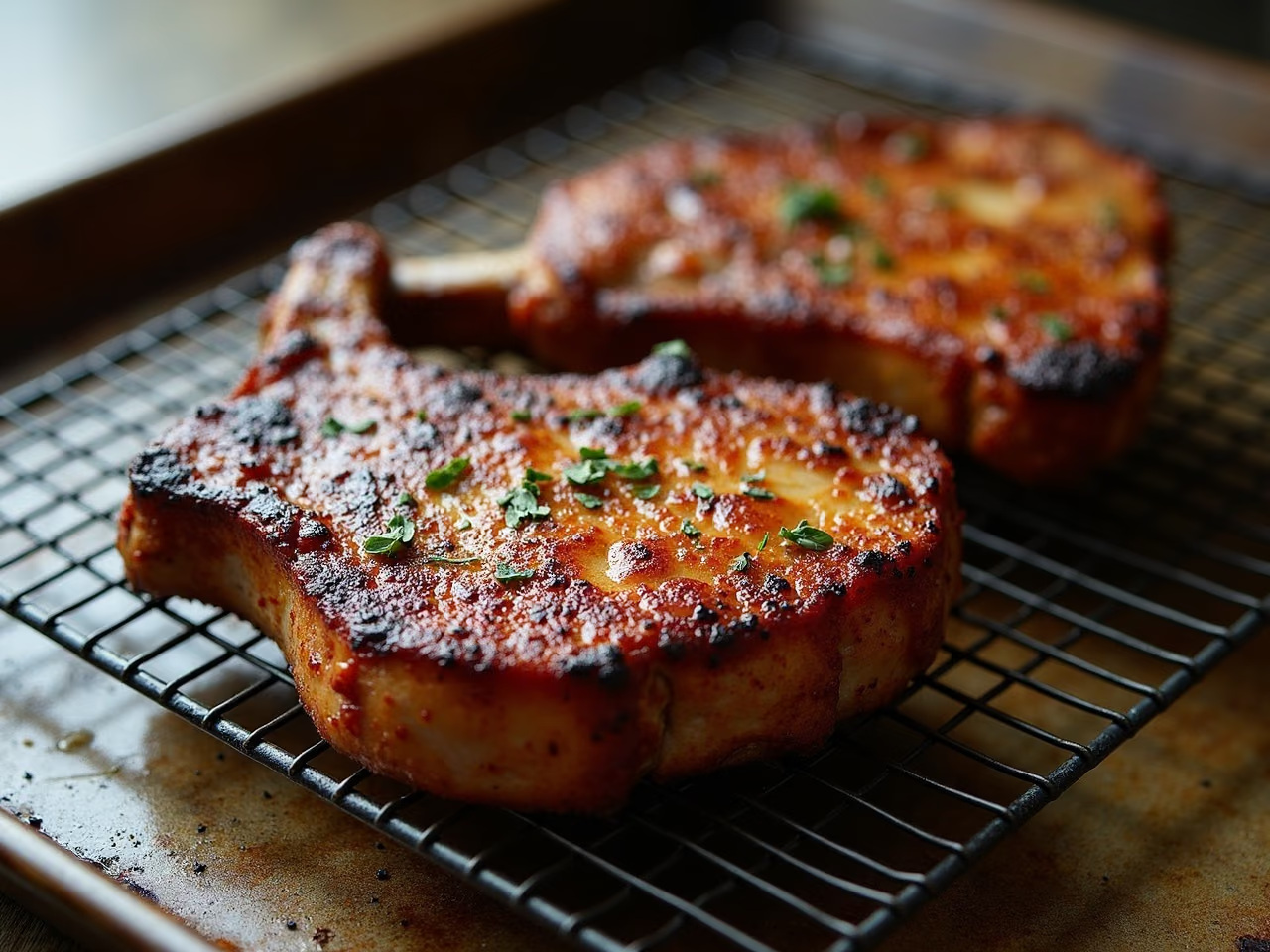
Pork chops are sold in a wider range of thicknesses than almost any other cut — from half-inch supermarket chops to two-inch butcher cuts — and a single baking time cannot cover that range. This page is the table.
Baking times from raw
At 400°F (200°C), on a wire rack, uncovered, chops rested 15 minutes out of the fridge:
| Thickness | Boneless | Bone-in |
|---|---|---|
| 1/2 inch (1.3 cm) | 8–11 min | 10–13 min |
| 3/4 inch (2 cm) | 12–15 min | 15–18 min |
| 1 inch (2.5 cm) | 15–18 min | 18–22 min |
| 1 1/4 inches (3 cm) | 19–23 min | 22–26 min |
| 1 1/2 inches (4 cm) | 22–26 min | 25–30 min |
| 2 inches (5 cm) | 30–35 min | 33–38 min |
Every one of those ends at the same place: pull at 140°F, rest 5 minutes, serve at 145°F. The time gets you close; the thermometer is what actually tells you.
Other oven temperatures
If your oven is already at another temperature for something else, adjust from the 400°F column rather than guessing:
| Oven | Adjustment | 1-inch bone-in chop |
|---|---|---|
| 350°F / 175°C | +8–10 min | 27–32 min |
| 375°F / 190°C | +4–6 min | 23–27 min |
| 400°F / 200°C | baseline | 18–22 min |
| 425°F / 220°C | −3–4 min | 15–18 min |
| 450°F / 230°C | −5–6 min | 13–16 min |
The trade-off is consistent: lower and slower gives you a more evenly cooked chop with a pale exterior; hotter gives you better colour and a wider band of overcooked meat just under the surface. 400°F is where those two balance for a chop of ordinary thickness.
Why bone-in runs longer
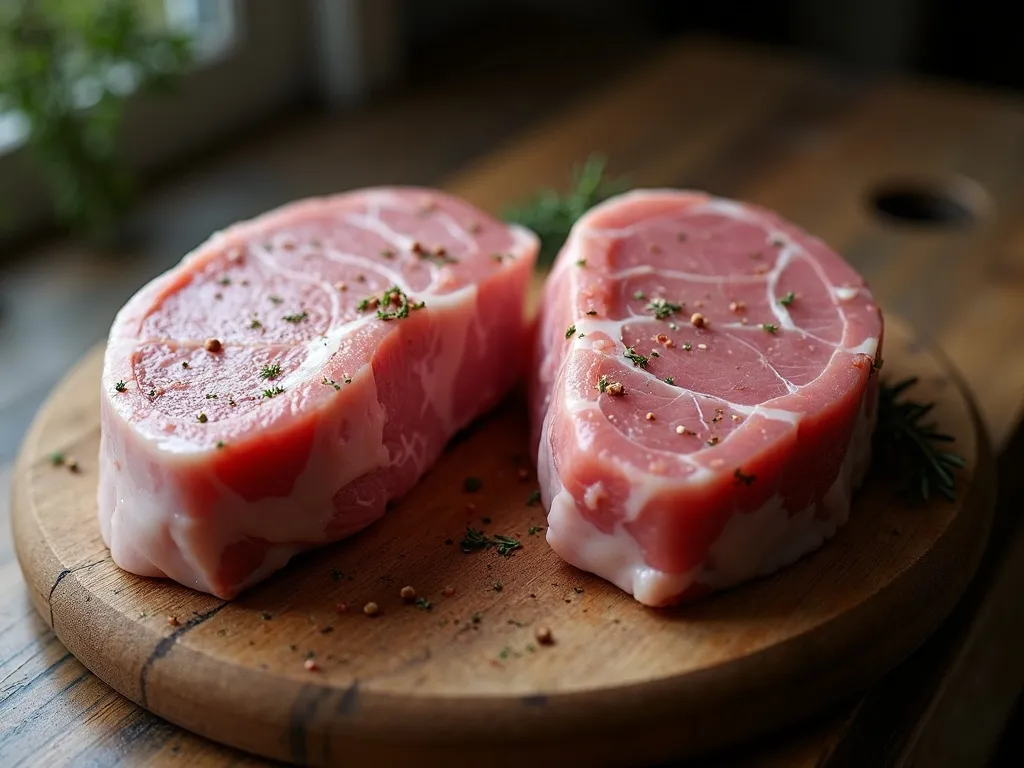
Bone conducts heat more slowly than muscle. In a bone-in chop, the meat sitting against the bone is the last part to come up to temperature, which is why the chop as a whole needs 3–5 minutes more than a boneless one of identical thickness.
The same physics causes the most common thermometer error with this cut. If the probe tip rests against the bone, it reads the bone — which is cooler — and reports a lower number than the meat around it. Push the probe into the thickest part of the muscle, angled away from the bone, and stop in the middle.
The upside of bone-in is that it is considerably harder to ruin. That slower, more gradual heating gives you a wider window between “done” and “dry”, so if you are cooking pork chops for the first time, buy bone-in.
Measure thickness, not weight
Packets are labelled by weight, and weight tells you almost nothing about cooking time. A wide, flat 8 oz chop and a narrow, thick 8 oz chop need times that differ by ten minutes.
Stand a chop on its edge next to a ruler and measure the deepest point. It takes five seconds and it is the single input this whole page depends on. If the chops in the packet differ from each other — they usually do — either group them by size across two pans, or pull the thinner ones out early.
Rack, space, and dry surfaces
Three things make the difference between chops that bake and chops that stew:
A wire rack. Sitting flat on a pan, the underside of the chop sits in its own rendered juices at pan temperature and effectively poaches. Raised, hot air reaches all sides.
Space. An inch between chops. Crowded, they release moisture faster than the oven can carry it away and the whole pan drops into steaming.
A dry surface. Pat them properly dry before oiling. Surface water has to boil off before anything else happens, and that is time the interior spends cooking.
Baked Pork Chops: Times by Thickness and Cut
- Prep
- 5 min
- Cook
- 20 min
- Total
- 25 min
- Serves
- 4 chops
Ingredients
- 4 pork loin chops, bone-in or boneless, 3/4 to 1 1/2 inches (2–4 cm) thick
- 1 tablespoon olive oil
- 1 teaspoon fine sea salt
- 1/2 teaspoon freshly ground black pepper
- 1 teaspoon smoked paprika
- 1/2 teaspoon garlic powder
- 1/2 teaspoon dried thyme
Method
- Heat the oven to 400°F (200°C). Set a wire rack inside a rimmed sheet pan — raised chops cook evenly from all sides instead of steaming in their own juices on the pan floor. (15 min)
- Take the chops out of the fridge while the oven heats and pat them completely dry. A fridge-cold chop needs 3–4 extra minutes and cooks less evenly edge to centre. (15 min)
- Measure the thickest point of the chops with a ruler. This is the number that decides the time — not the weight on the packet, and not how many chops are on the pan.
- Mix the salt, pepper, paprika, garlic powder and thyme. Rub the chops with oil, then coat evenly with the spice mix.
- Arrange on the rack with at least an inch between them. Bake according to the table on this page — for a 1-inch boneless chop at 400°F that is 15–18 minutes; for 1-inch bone-in, 18–22. (20 min)
- Start checking 3 minutes before the low end. Insert an instant-read thermometer into the thickest part, not touching bone. Pull the pan at 140°F (60°C).
- Rest the chops on a warm plate for 5 minutes. The centre climbs to about 145°F (63°C) and the juices settle back into the meat. (5 min)
Notes
- Baking from raw gives you an evenly cooked chop with a pale surface. If you want browning as well, sear 2 minutes a side first and take 5–7 minutes off the oven time — the sear does no meaningful cooking, only colour.
- Thin chops under 3/4 inch are a poor fit for the oven. By the time the centre is at temperature the outside is dry. Cook those in a hot pan for 3 minutes a side instead.
- A crowded pan steams. If four chops do not fit with an inch of space, use two pans rather than tucking them together.
- Convection or fan ovens run hotter — cut 25°F (about 15°C) off the temperature or start checking 4 minutes early.
- The times assume chops that have sat out 15 minutes. Straight from the fridge, add 3–4 minutes and expect a wider band of overcooked meat near the surface.
Per serving (estimated by calculation from ingredient quantities, not laboratory tested): 312 kcal · 38 g protein · 1 g carbohydrate · 17 g fat.
Common questions
How long do you bake pork chops at 400 degrees?
From raw, at 400°F (200°C): a 3/4-inch boneless chop takes 12–15 minutes, a 1-inch boneless 15–18, a 1-inch bone-in 18–22, and a 1 1/2-inch bone-in 25–30. Bone-in always runs longer than boneless at the same thickness. Pull at 140°F and rest 5 minutes rather than baking to a fixed time — chop thickness varies far more between packets than most recipes admit.
How long to bake pork chops at 350 or 375?
At 375°F (190°C), add roughly 4–6 minutes to the 400°F times: a 1-inch bone-in chop runs 23–27 minutes. At 350°F (175°C), add 8–10 minutes, so the same chop takes 27–32. Lower heat gives a more evenly cooked interior with almost no surface colour; higher heat browns better but widens the overcooked band under the crust.
Do bone-in pork chops take longer to cook than boneless?
Yes, about 3–5 minutes longer at the same thickness. Bone conducts heat more slowly than meat, so the flesh immediately around it lags behind the rest of the chop. That is also why you must not let the thermometer probe touch the bone — it reads the bone temperature and tells you the chop is done several minutes early.
What temperature should baked pork chops be?
145°F (63°C) with a 3-minute rest, which the USDA revised down from 160°F in 2011. Pull the chops from the oven at 140°F and let carryover cooking take them the rest of the way — a chop pulled at 145°F rests to about 150°F and starts to dry. At 145°F the centre is faintly pink, which is normal and safe for whole cuts of pork.
Should pork chops be covered when baking?
No, not for these times. Covering traps steam, which keeps the chops moist but leaves the surface pale and soft and adds 3–5 minutes. If you are baking chops in a sauce you want to stay liquid, cover; otherwise leave them open and rely on pulling at the right temperature to keep them juicy.